


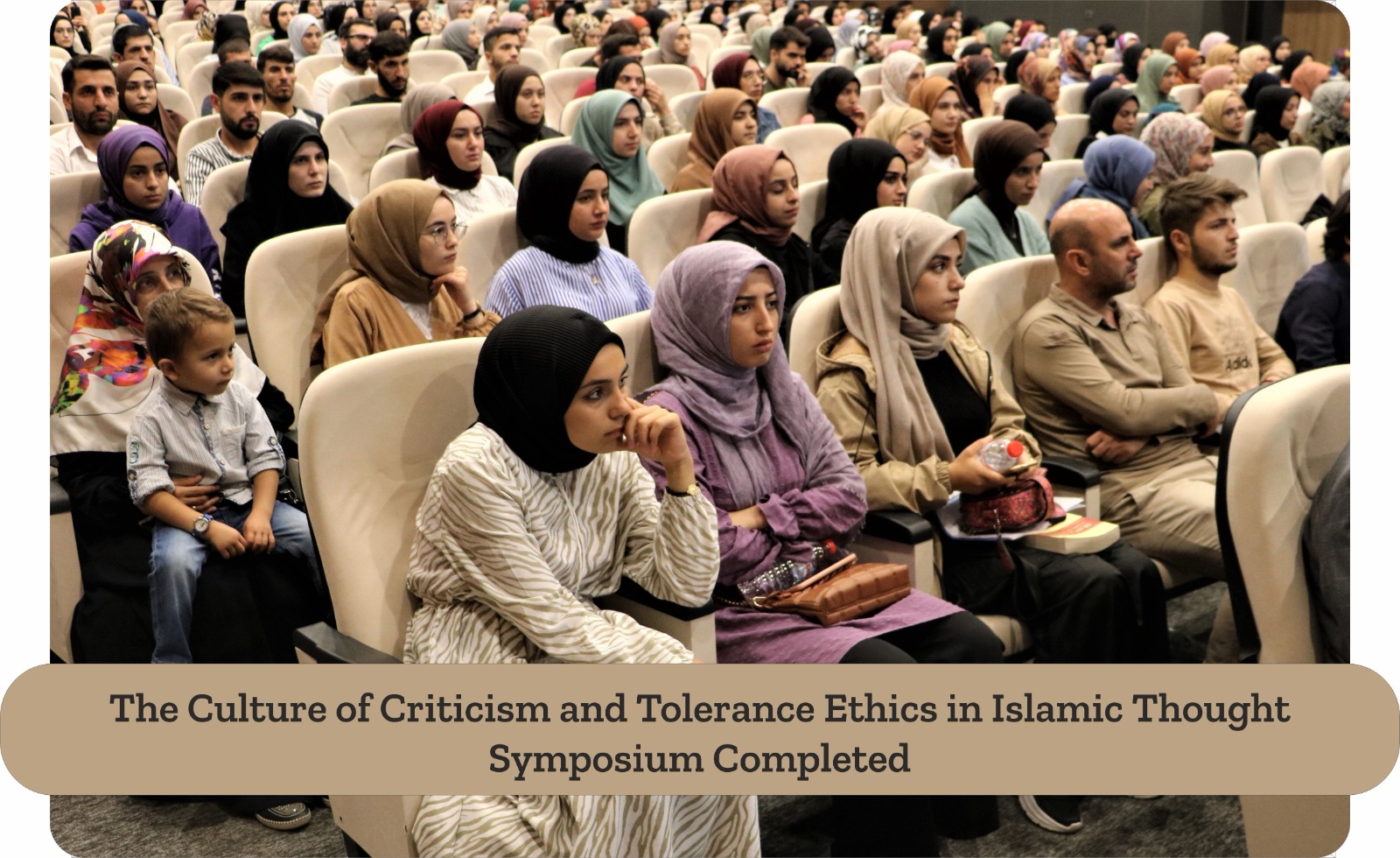
The Culture of Criticism and Tolerance Ethics in Islamic Thought Symposium Completed
The Faculty of Islamic Sciences of MAUN held the fourth series, the last of the symposium series on the Culture of Criticism and Tolerance Ethics in Islamic Thought, online. The first of this series was held on April 26-28, 2019, the second (Classical Period: Between M. VII-XII Centuries) on December 7-8, 2020, the third (Between XII-XIX Centuries) on May 28-29, 2021, the fourth (Modern Period) was on October 7-8, 2022.
In the first series of the Symposium on the Culture of Criticism and Tolerance Ethics in Islamic Thought, 41 sessions were held and 123 papers were presented. 12 sessions were held and 39 papers were presented in the second symposium, which dealt with the period between the centuries Gregorian VII-XII. The books consisting of these papers were published by Ensar Publications with the contributions of the Islamic Sciences Research Foundation (İSAV). A total of 15 sessions were held in the third symposium, which centred between the centuries Gregorian XII-XIX, and 48 separate papers were presented in these sessions. The papers collected under the title of “The Culture of Criticism and Tolerance Ethics in Islamic Thought-III” were published by İlbey Publishing, again with the contributions of ISAV. The last symposium based on the Modern Era was held in 13 sessions. 37 academics contributed to these online sessions with their papers.
The greeting speeches of the fourth symposium, which was held with the support of the Islamic Sciences Research Foundation (İSAV) were delivered by the Dean of the Faculty of Islamic Sciences Murat Serdar and Prof. Dr. Fethi Ahmet Polat, the Rector of Muş Alparslan University. The opening conference of the symposium was made by the President of the Institute of Islamic Thought Prof. Dr. Mehmet Görmez. Mehmet Görmez started his speech by basing the method of criticism and the morality of conflict in the context of the data in the Qur'an and the Sunnah. Then, by referring to the main problems related to the method of criticism and the morality of conflict in the modern period, he focused on how to develop a method that will pave the way for Muslims in this regard and what the basic principles are. 37 academics in the fields of Tafsir, Hadith, Kalam, Fiqh, Islamic History, Sufism and Philosophy contributed to the symposium, which was held in 13 sessions in total. In the sessions with intense participation, the audience also had the opportunity to express their thoughts and ask questions in the question-answer section.
Evaluating the demands from both the public and academics regarding the importance of the culture of criticism and the ethics of tolerance, the Rectorate of Muş Alparslan University and the management of the Faculty of Islamic Sciences came to the conclusion that it would be beneficial to discuss the Culture of Criticism and Tolerance Morality in Islamic Thought as a four-stage series. Especially Rector of Muş Alparslan University Prof. Dr. Fethi Ahmet Polat both pioneered and mobilized all necessary means to organize the symposiums in a way that would encompass the entire Islamic thought by dividing them into periods.
When we consider the hinterland of Islamic civilization, which encompasses a wide geography, a long historical period and numerous human communities, we can say that Islamic thought and the sciences that emerged within this framework have brought a unique collection to the world cultural heritage in every field. The main objective of the symposium is that the efforts to discover the accumulation of this collection on the culture of criticism and the morality of tolerance will provide exceptional guidance both to the conflicts and conflicts in the Islamic world and to the chaos and turmoil that humanity has fallen into.
The speeches of the closing session of the symposium were made by Prof. Dr. Fethi Ahmet Polat, Prof. Dr. Ibrahim Kutluay, Prof. Dr. Recep Aslan and Assoc. Dr. Huseyin Kurt.
Fethi Ahmet Polat focused on the issue of monopoly of truth. He also emphasized the ideals of those who want to monopolize the truth, to bring together different monopolies and to form a truth cartel. He stated that after a while, when there is no criticism, people begin to see themselves as the representative of the truth, and that if we believe in the power of the truth to catch and affect everyone, the monopoly of the truth and the cartelism of the truth would be avoided. Polat stated that he had the idea of continuing the symposiums.
İbrahim Kutluay stated that with the four symposiums held, the knowledge about the culture of criticism and the morality of tolerance in Islamic thought was discovered, but was just at the bottom of the ladder and that this issue should be addressed from different aspects in different channels of the academy in the future.
Recep Aslan stated that this symposium is complementary to other symposiums. He also pointed out that the Book and wisdom are used together in the Qur’an, emphasizing that the wisdom here is to follow the truth, and that these symposiums lead us to follow the truth. Aslan offered to restart these symposiums under another name.
Hüseyin Kurt stated that he is of the opinion to reinterpret Islamic disciplines and restructure the Faculties of Theology-Islamic Sciences to meet the needs.
The symposium ended with the thanks speeches of Deputy Dean of Islamic Sciences Assoc. Dr. Cahit Karaalp, Dean of the Faculty of Islamic Sciences Murat Serdar and Prof. Dr. Fethi Ahmet Polat, Rector of Muş Alparslan University.